Is It Bad to Leave My Phone Charging Overnight on Android? (2026)
is it bad to leave my phone charging overnight android users ask — and the reassuring truth is that modern phones are built for exactly this. Your Android stops pulling significant current once it hits 100 percent, so the old fear of “overcharging” is outdated. But overnight charging is not completely free of consequences: heat and long hours at full charge do wear the battery down a little faster over the years.
This guide explains what actually happens during those eight hours on the charger, why heat matters more than anything else, the settings that protect your battery while you sleep, and the few situations where overnight charging genuinely is a bad idea.
The Short Answer: Your Phone Is Smarter Than Old Chargers
A decade ago, leaving a phone plugged in all night meant the charger kept pushing current into an already-full battery. Modern Android phones do not work that way. Every phone has a battery management system — a dedicated chip plus software — that controls charging precisely:
- Charging stops at 100 percent. Once full, the phone cuts the charge current to nearly zero and runs directly off the charger. It then lets the battery drift down a percent or two before topping up again — a gentle trickle, not a constant flood.
- Fast charging backs off automatically. Your phone charges fastest when the battery is low and slows dramatically past 80 percent. Those last hours overnight are the gentlest part of the cycle.
- Temperature is monitored constantly. If the phone gets too warm, charging slows or pauses until it cools. This protection runs whether you are watching or asleep.
So no, your phone will not “overcharge” in the classic sense. The battery management system solved that problem years ago. The real question is subtler: does sitting at 100 percent for hours, night after night, age the battery faster? Slightly — yes. And that is what the rest of this guide addresses.
Why Heat Is the Real Enemy of Overnight Charging
If overcharging is a solved problem, heat is the one that remains. Lithium batteries degrade faster when they are warm, and charging generates warmth — especially fast charging. An extra few degrees, sustained over hundreds of nights, measurably shortens a battery’s lifespan.
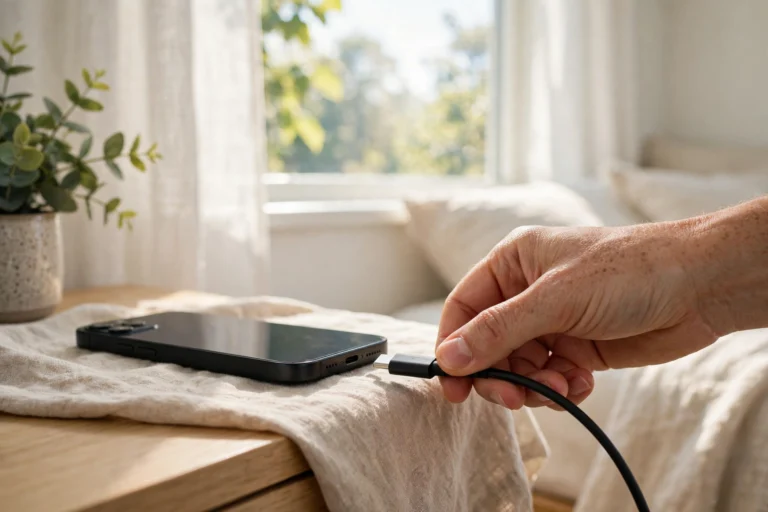
- Never charge under your pillow or blanket. This is the single most important rule. Trapped heat with no airflow is how phones overheat overnight — and in rare, extreme cases, how fires start.
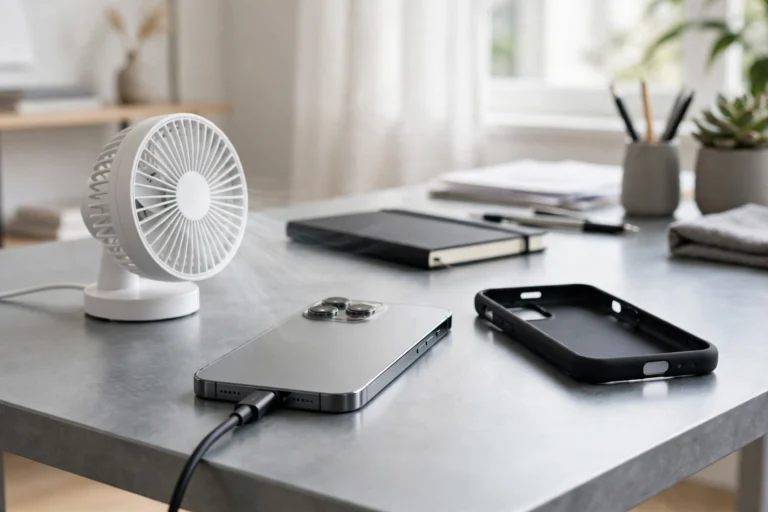
- Charge on a hard, cool surface. A nightstand, desk, or dresser lets heat dissipate. A bed, couch cushion, or pile of laundry does not.
- Take off thick cases if the phone runs warm. Heavy-duty rugged cases insulate the phone. If yours feels toasty after charging, pop the case off at night.
- Keep it out of direct sun and away from heaters. Obvious, but a nightstand next to a sunny window or a radiator vent adds heat all night long.
“Heat is the silent battery killer. A phone that charges cool at night will outlast an identical phone that charges warm — every single time.”
A phone that feels barely warm in the morning is charging correctly. One that feels hot has a ventilation problem worth fixing, regardless of any other setting.
What Sitting at 100 Percent Does to Battery Health
Here is the subtle cost of overnight charging: lithium batteries age fastest at high voltage, and 100 percent charge is maximum voltage. A battery held at full charge for six extra hours every night experiences more chemical stress than one that spends those hours at 60 or 80 percent. Over two to three years, this can mean the difference between a battery at 90 percent health and one at 80 percent.
The good news is that manufacturers now build in tools to fight exactly this:
- Samsung: Protect battery. Go to Settings > Battery > Battery protection and choose Maximum — charging caps at 80 percent. There is also an Adaptive option that learns your wake time and finishes the last stretch just before your alarm.
- Google Pixel: Adaptive charging. On Pixels, Settings > Battery > Adaptive charging slows the overnight charge so the phone reaches 100 percent right around your morning alarm instead of sitting full for hours.
- OnePlus, Motorola, and others. Look for Optimized charging, Overnight charging protection, or similar under Battery settings — most brands now include some version of this.

If your phone offers an 80 percent cap, it is the single best thing you can do for long-term battery health — far more impactful than unplugging at some exact minute. Losing 20 percent of daily capacity is a small price for a battery that stays healthy an extra year or two.
How to Charge Overnight the Smart Way
You do not need to give up the convenience of waking to a full phone. Combine these habits and overnight charging becomes nearly harmless:
- Enable adaptive or optimized charging. This is step one — let the phone time its own finish to your alarm.
- Use the 80 percent cap if you can spare it. If you end most days above 30 percent, you do not need 100 percent every morning. Cap it and forget it.
- Charge in a cool, ventilated spot. Hard surface, case off if it runs warm, never under bedding.
- Use a quality charger and cable. Certified chargers deliver clean, stable power and communicate correctly with the phone’s battery management. Cheap no-name bricks can run hot and confuse the charging logic.
- Skip the fastest charger at night. If you have a slow 10–15W brick in a drawer, use it for overnight charging. Slower charging means less heat, and speed does not matter while you sleep.
These five habits together reduce both heat and high-voltage stress — the two real aging factors — without changing your routine at all.
When Overnight Charging Genuinely Is a Bad Idea
For a healthy phone with a good charger, overnight charging is fine. But stop doing it — and get the phone checked — if any of these apply:
- The battery is swollen. A bulging back, lifting screen, or phone that rocks on a flat table means a damaged battery. Do not charge it overnight — do not charge it at all. Take it for professional disposal.
- The phone gets very hot while charging. Warm is normal; uncomfortably hot is not. Persistent overheating signals a failing battery or a bad charger.
- You are using a damaged cable or sketchy charger. Frayed cables and uncertified bricks are the actual fire-risk scenario people worry about. Replace them before anything else.
- The phone is already damaged. A phone with a cracked back exposing internals, or one that took a swim recently, should not charge unsupervised.
FAQ
Should I unplug my phone at 100 percent or leave it?
Leave it — unplugging at exactly 100 percent gains you nothing, since the phone already stopped active charging. What helps is the 80 percent cap or adaptive charging, which reduce the hours spent at full voltage.
Does wireless charging overnight damage the battery more?
Slightly, because wireless charging generates more heat than wired. If you charge wirelessly overnight, make sure the phone is aligned properly on the pad (misalignment creates extra heat) and the area is ventilated.
Is it better to charge to 80 percent twice a day than 100 percent overnight?
For battery longevity, yes — shallower cycles between roughly 20 and 80 percent are the gentlest pattern. But the difference is modest, and convenience matters too. An 80 percent overnight cap gets you most of the benefit with none of the hassle.
Do I need a special “overnight” charger?
No. Any quality charger works — and a slower one is actually preferable at night since it runs cooler. Save your fastest brick for daytime top-ups when speed matters.
Will overnight charging void my warranty?
No. Manufacturers expect overnight charging and design for it — it is why adaptive charging features exist. Battery degradation from normal use is covered under standard warranty terms for manufacturing defects, though gradual capacity loss is considered normal wear.
Conclusion
So is it bad to leave my phone charging overnight android owners wonder? Not really — your phone’s battery management system prevents overcharging, and the convenience of waking to 100 percent is something manufacturers design around. The modest costs are heat and long hours at full voltage, and both have easy fixes.
Turn on adaptive charging, consider the 80 percent cap, charge on a cool hard surface with a quality charger, and never under your pillow. Do that, and overnight charging goes from a source of worry to a complete non-issue — your battery will thank you two years from now.