How to Make Money Voice Acting From Home (2026)
How to make money voice acting from home is simpler than most people think: set up a quiet recording corner, record auditions with a decent microphone, and start landing paid gigs on voice casting platforms. Clients pay anywhere from $50 for a short YouTube narration to $2,000+ for a national commercial — and the barrier to entry is lower than ever because your home can be your studio.
This guide covers what voice actors actually earn, the equipment you need on a budget, how to train your voice, where to find paying work, and the exact process for winning your first clients.
What Voice Acting From Home Actually Pays
Rates vary by project type, but here is the realistic range working voice actors see in 2026:
- YouTube narration and explainer videos: $50–$250 per video
- E-learning and corporate training: $150–$500 per finished hour of audio
- Audiobooks: $100–$300 per finished hour, or royalty-share deals on platforms like ACX
- Podcast intros and ads: $75–$300 per spot
- Regional commercials: $250–$1,000+ per spot
- Video games and animation: $200–$1,000+ per session
A beginner doing 3–4 short jobs per week can realistically earn $500–$1,500/month within the first year. Established freelancers with repeat clients commonly earn $3,000–$8,000/month. The work compounds: clients who hire you once keep coming back when you deliver clean audio on time.
Voice acting is usually priced per finished hour — one hour of final audio takes roughly 6–10 hours of recording and editing when you are starting out. Factor your full time into every quote.
The Equipment You Need to Start
You do not need a professional studio. Almost every home voice actor starts with this budget setup:
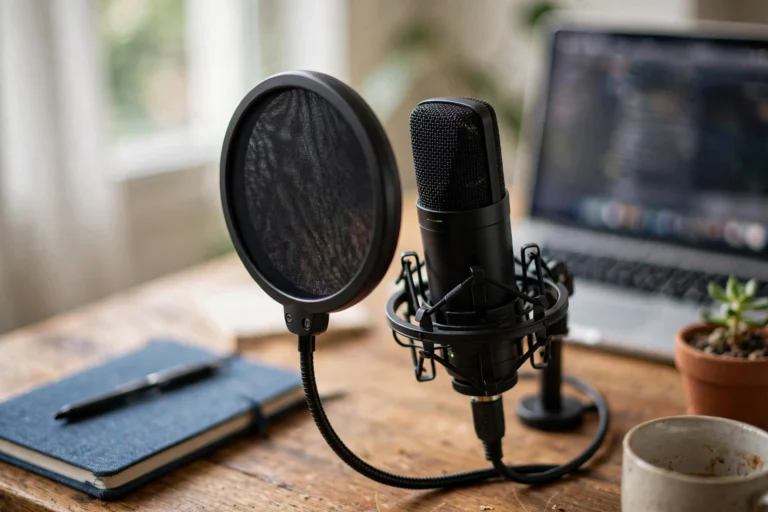
- Microphone: Audio-Technica AT2020 USB+ or Rode NT-USB ($99–$169). Skip $30 microphones — clients can hear the difference instantly.
- Headphones: closed-back like the Sony MDR-7506 ($99), so your mic does not pick up playback audio.
- Recording software: Audacity (free) or Reaper ($60). Both handle noise reduction, EQ, and clean exports easily.
- Pop filter: $10–$15. Removes harsh “p” and “b” plosive sounds.
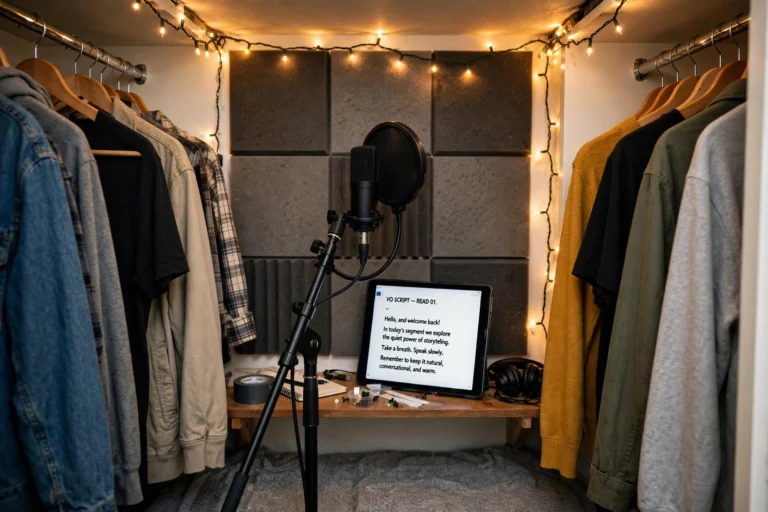
- Quiet recording space: a walk-in closet full of clothes outperforms a cheap foam booth. Fabric absorbs echo naturally.
Total starter budget: $150–$350. That is genuinely all you need to deliver client-ready audio.
Train Your Voice: It’s a Skill, Not a Gift
Nobody is born a voice actor. Working voice actors build their ability deliberately, and you can too:
- Read aloud 20 minutes daily. News articles, books, ads — anything. Focus on pacing, pauses, and sounding natural rather than “announcer-like.”
- Warm up before recording. Lip trills, tongue twisters, and humming scales for five minutes loosen your voice and cut mouth noise.
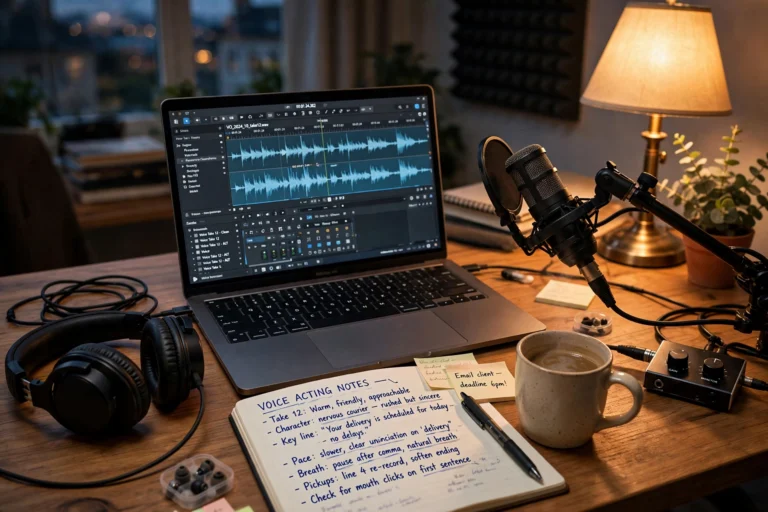
- Record and listen back. This is uncomfortable and essential. You will hear filler words, uneven pacing, and mouth clicks you never noticed.
- Learn mic technique. Stay 4–6 inches from the mic, slightly off-axis. Never eat or drink dairy right before recording — it increases mouth noise.
- Study the pros for free. YouTube voice acting coaches cover breath control, character voices, and audition technique at no cost.
- Consider paid coaching. One or two private sessions ($50–$100 each) can fix habits that would otherwise cost you jobs for months.
Clients hire clarity and consistency far more than a “deep movie-trailer voice.” A normal, expressive voice recorded cleanly wins most beginner jobs.
Where to Find Paid Voice Work
Voice Casting Platforms
These marketplaces connect voice actors with clients daily — most beginners land their first paid work here:
- Voices.com — the largest marketplace; membership required, but the job volume justifies it once you are auditioning daily.
- Voices123 — tiered memberships; strong for commercials and corporate narration.
- Bodalgo — popular in Europe, flat annual fee, quality clients.
- Bunny Studio — invite-based but beginner friendly; consistent work if you are accepted.
- ACX — Amazon’s audiobook platform; royalty-share deals let you narrate books with zero upfront investment.
- Fiverr and Upwork — lower rates, but great for building reviews and portfolio samples fast.
Direct Clients Pay Better
Platform fees add up, so many voice actors eventually go direct. The best targets:
- YouTube channels that publish narrated content daily (true crime, finance, history) — email them a short demo.
- E-learning companies producing course audio every month.
- Indie game developers on itch.io and Discord — smaller budgets, but real credits and repeat work.
- Podcasters who need intros, ads, and episode narration.
How to Win Auditions and Land Your First Clients
Auditioning is a numbers game. Follow this process and your win rate will climb fast:
- Build a 60–90 second demo reel. Record 4–5 short samples in different styles: commercial, narration, e-learning, character. This is your resume — make it clean.
- Audition every single day. Top voice actors submit 10–20 auditions daily. Beginners who treat it like a job get hired; those who wait for luck do not.
- Match the brief, not yourself. If the client asks for “warm, friendly, upbeat,” deliver exactly that. Do not show range they did not ask for.
- Send only one take unless asked. Clients skim dozens of auditions. Your first 5 seconds decide everything — start strong, no throat clearing.
- Deliver broadcast-ready audio. No background noise, no echo, consistent levels, exported as high-quality WAV or MP3. Technical quality is the first filter.
- Follow up once. A polite check-in 5–7 days after submitting can revive a stalled decision. One follow-up is professional; three is not.
- Undercut on speed, not price. Never race to the bottom on rates. Win clients with 24-hour turnaround and flawless audio instead.
The AI Question: Will AI Voiceovers Replace You?
AI narration tools keep improving — if you want to understand the technology, our guide to using ElevenLabs for voiceovers breaks down what AI voices can and cannot do. The honest picture: AI handles flat, informational narration well. It still fails at emotional delivery, character work, comedy timing, and brand voices clients pay a premium for.
Human voice actors are not disappearing — they are moving upmarket. Position yourself where AI is weakest: storytelling, emotion, accents, and characters. Meanwhile, some voice actors actually earn extra money licensing their own voice to AI companies, turning the threat into another income stream.
FAQ
How much does it cost to start voice acting from home?
$150–$350 covers a quality USB microphone, closed-back headphones, a pop filter, and free recording software. A closet full of clothes serves as your recording booth. You can upgrade to an XLR mic and audio interface ($300–$500 more) once jobs are paying for themselves.
Do I need professional training to make money voice acting?
No, but structured practice matters more than talent. Daily reading-aloud practice, free coaching videos, and recording yourself will take you surprisingly far. One or two paid coaching sessions can fix bad habits early — worth it, but not required to start earning.
Can I do voice acting with just a phone?
You can practice with a phone, but clients expect clean, professional audio — phone recordings have too much room noise and compression for paid work. The $150–$350 starter setup above is the minimum for landing actual jobs.
How long until I earn money as a voice actor?
Most beginners land their first paid gig within 1–3 months of auditioning daily. Expect slow income for the first 6 months while you build reviews, then a sharp acceleration as repeat clients and direct bookings grow. Consistency beats talent in the early months.
Conclusion
How to make money voice acting from home comes down to a simple loop: invest $150–$350 in basic equipment, turn a quiet corner into a recording space, audition daily on casting platforms, and deliver clean audio on time. Your voice does not need to be special — it needs to be reliable, well-recorded, and matched to what the client asked for.
Start this week: order the microphone, record your demo reel in your closet, and submit your first five auditions. The voice actors earning thousands a month started exactly where you are now.
Related: How to Make Money Transcribing Online for another audio-based income stream, and How to Use ElevenLabs for Voiceovers to understand the AI side of the voice industry.