How to Make Money on YouTube Without Showing Your Face (2026)
How to make money on YouTube without showing your face is simpler than most people think: pick a faceless niche, create videos using voiceovers, screen recordings, stock footage, or animation, and earn through ads, affiliate links, and sponsors once your channel qualifies. Thousands of channels earn full-time income without the creator ever appearing on camera.
This guide covers how faceless channels make money, the 10 best niches for 2026, the free tools you need, YouTube’s monetization rules (including the reused-content trap that kills most faceless channels), and a 30-day plan to your first payout.
How Faceless YouTube Channels Actually Make Money
Faceless channels earn the same ways on-camera channels do. Here is where the money comes from:
- Ad revenue (YouTube Partner Program): YouTube places ads on your videos and pays you a share. Rates vary wildly by niche — finance and software channels earn $15–$40 per 1,000 views (RPM), while entertainment niches earn $2–$8. Niche choice directly sets your income ceiling.
- Affiliate marketing: You recommend products or tools in your videos and earn a commission on sales through your links. A single “best budget microphones” video can earn affiliate income for years. This is often bigger than ad revenue for small channels.
- Sponsorships: Brands pay you to feature their product, often $20–$50 per 1,000 views on a dedicated segment. You do not need a huge audience — sponsors pay for targeted audiences, which faceless niche channels have.
- Digital products: Many faceless creators sell templates, presets, ebooks, or courses related to their niche. This is where channels scale from hundreds to thousands per month.
- Memberships and Super Thanks: Once monetized, loyal viewers can pay monthly or tip on individual videos. Works best in tutorial and commentary niches.
The golden rule: high-RPM niches (finance, software, business, health) pay 5–10x more per view than entertainment niches. A 50,000-view finance video can out-earn a 500,000-view meme compilation. Pick your niche like an investor, not a hobbyist.

10 Proven Faceless YouTube Niches for 2026
These niches work specifically because viewers care about the information or experience, not the person delivering it:
- Personal finance explainers: Budgeting and investing basics narrated over motion graphics. The highest RPM niche on the platform.
- Software tutorials: Screen-recorded walkthroughs of Excel, Notion, or AI tools. Evergreen, searchable, and sponsors love them.
- True crime and mystery: Narrated stories over maps and timelines. Massive watch time, which YouTube rewards heavily.
- Relaxing content: Rain sounds, lo-fi music, fireplace videos. Low effort per video, enormous cumulative views.
- Top-10 and list videos: “10 most expensive…”, “7 hidden features…” — a simple format, endlessly repeatable in any topic.
- Reddit story readings: AI or human narration of interesting threads. Huge audience — but read the reused-content warning below first.
- Motivational compilations: Famous speeches edited with cinematic stock footage. Crowded, but works with genuinely original editing.
- Health and psychology explainers: “Why you can’t sleep”, “Signs of burnout” — animated explainers with strong search demand.
- History documentaries: “What really happened in…” with maps and narration. High watch time and loyal subscribers.
- AI tool news: Covering new AI tools as they launch. Search spikes with every release, and affiliate links convert well.
Pick one niche and commit to at least 30 videos before judging it. Channels fail from topic-hopping, not from bad niches.

What You Need to Start (The Free Stack)
You do not need a camera, a studio, or paid software. This free stack is what most successful faceless channels started with:
- Your voice or an AI voiceover: Record with your phone in a closet (clothes absorb echo well) or a $30 USB mic. If you dislike your voice, AI voice tools like ElevenLabs or CapCut’s text-to-speech produce natural narration — just add your own script and editing so the content is original.
- Free editing software: CapCut (easiest) or DaVinci Resolve (most powerful). Both handle voiceover, stock footage, captions, and music with no watermark.
- Free visuals: Pexels and Pixabay for stock footage, Canva for thumbnails and motion graphics. Never download random Google Images — copyright strikes will kill your channel.
- A script: Write 800–1,200 words per 8–10 minute video. ChatGPT or Claude can draft outlines, but rewrite in your own words — YouTube’s reused-content policy (below) punishes copy-paste channels.
Here is the kind of simple script opening that works for a finance explainer:
“In this video, I’ll show you the 5 budgeting mistakes keeping you broke in 2026 — and the 10-minute fix for each one. Mistake number one is the one almost everyone makes…”
Short hook, clear promise, numbered structure. That formula works in almost every faceless niche.
YouTube’s Monetization Rules (Read This First)
Before you upload a single video, understand the two gates every channel must pass:
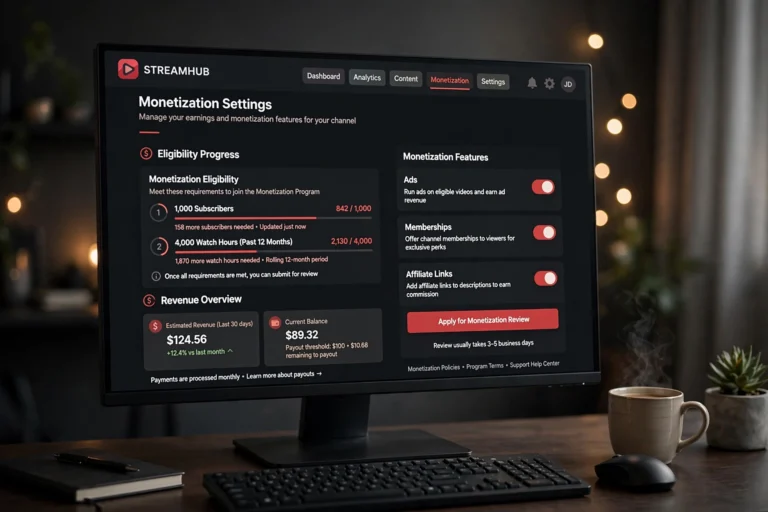
- Gate 1 — YouTube Partner Program: 1,000 subscribers plus either 4,000 valid public watch hours in the last 12 months or 10 million valid Shorts views in 90 days. Only then can you earn ad revenue.
- Gate 2 — The reused-content policy: This is where most faceless channels die. YouTube rejects monetization for channels that re-upload other people’s content with minimal changes — unedited compilations, robot-read Reddit posts over random gameplay, slideshows of stock photos with no commentary. Your content must add significant original commentary, editing, or educational value.
How to stay safe: write your own scripts, edit footage into a real narrative (not a slideshow), add your own voiceover or heavy commentary, and never re-upload full clips you do not own. Originality is the whole business model — it is also what makes sponsors and affiliates want to work with you.
Step-by-Step: Launch Your Faceless Channel in 30 Days
- Days 1–3: Pick your niche and study 10 competitors. Watch the top channels in your niche and note their video length, title formulas, thumbnail style, and upload frequency. Your goal is to understand the pattern, then execute it better.
- Days 4–5: Set up the channel properly. Clear channel name, keyword-rich About description, consistent branding (Canva logo + banner), and one good channel trailer explaining what viewers get.
- Days 6–10: Produce your first 5 videos. Script, record voiceover, edit, design thumbnails. Aim for 8–12 minutes each — long enough for mid-roll ads later, short enough to finish. Quality matters more than speed at this stage.
- Days 11–30: Publish 2–3 videos per week. Batch-produce on weekends. Every title should target a search term or a proven viral format from your niche research.
- Optimize every upload: keyword in the title and first two lines of the description, 3–5 relevant tags, an end screen linking to your next video, and a pinned comment asking a question to drive engagement.
- Track and double down: After 15–20 videos, check Analytics. Find your highest click-through-rate topics and make more of exactly those. One breakout format can carry a channel.
How Long Until You Get Paid?
Honest timeline for a consistent beginner publishing 2–3 videos per week in a decent niche:
- Months 1–3: 0–500 subscribers, learning the craft. Earnings: $0. Affiliate links in descriptions can still earn small commissions.
- Months 3–6: First videos start ranking in search. Many channels hit the 1,000-subscriber / 4,000-hour threshold here.
- Months 6–12: Monetized mid-RPM channels typically earn $100–$1,000/month. High-RPM niches with 50k+ monthly views can pass $1,000.
- Year 2+: The catalog compounds — old videos keep earning while new ones stack on top. This is when it becomes genuinely passive.
This is a 6–12 month build, not a 30-day hack. If you need income sooner, affiliate links and sponsorships in your niche can pay from month one — our affiliate marketing for beginners guide explains exactly how to set that up.
FAQ
Can I monetize a faceless YouTube channel?
Yes — as long as you meet the Partner Program requirements (1,000 subscribers and 4,000 watch hours or 10M Shorts views) and pass the reused-content review. Videos need original commentary, editing, or educational value, not re-uploaded clips.
Do I need to use my real voice?
No. AI voiceovers are allowed. The key is original scripts and real editing — a robot voice reading copied content gets rejected, while an AI voice narrating your original script passes fine.
How much do faceless YouTube channels make?
At a $10 RPM, 100,000 monthly views earns roughly $1,000/month from ads. Finance channels at $25–$40 RPM earn 3–4x that from the same views. Most mid-size channels earn more from affiliates than ads.
What is the easiest faceless niche to start?
Software tutorials and list videos: free screen recording, simple editing, built-in search demand. Relaxing content is simpler to produce but earns very low RPMs.
Can I start a faceless channel with just my phone?
Yes. Record voiceovers on your phone, edit in the free CapCut app, design thumbnails in Canva. The script and niche matter far more than the gear.
Conclusion
How to make money on YouTube without showing your face comes down to three decisions: a high-RPM niche you can produce consistently, original scripts with real editing (so you pass the reused-content review), and a 2–3 video weekly schedule for at least six months. The channels that win are not the most talented — they are the most consistent.
Start this week: pick one niche from the list above, study ten competitor videos, and script your first five. Your first videos will be rough, and that is fine — every faceless channel earning five figures a month started with uploads nobody watched.
Related: How to Make Money Online as a Teenager for younger creators starting faceless channels, and What Is Affiliate Marketing for Beginners to add a second income stream from day one.